What’s New#
Here you can find the release notes for current and past releases of AutoGluon.
v1.0.0
Version 1.0.0
Today is finally the day… AutoGluon 1.0 has arrived!! After over four years of development and 2061 commits from 111 contributors, we are excited to share with you the culmination of our efforts to create and democratize the most powerful, easy to use, and feature rich automated machine learning system in the world. AutoGluon 1.0 comes with transformative enhancements to predictive quality resulting from the combination of multiple novel ensembling innovations, spotlighted below. Besides performance enhancements, many other improvements have been made that are detailed in the individual module sections.
Note: Loading models trained on older versions of AutoGluon is not supported. Please re-train models using AutoGluon 1.0.
This release supports Python versions 3.8, 3.9, 3.10, and 3.11.
This release contains 223 commits from 17 contributors!
Full Contributor List (ordered by # of commits):
@shchur, @zhiqiangdon, @Innixma, @prateekdesai04, @FANGAreNotGnu, @yinweisu, @taoyang1122, @LennartPurucker, @Harry-zzh, @AnirudhDagar, @jaheba, @gradientsky, @melopeo, @ddelange, @tonyhoo, @canerturkmen, @suzhoum
Join the community:
Get the latest updates:


Spotlight
Tabular Performance Enhancements
AutoGluon 1.0 features major enhancements to predictive quality, establishing a new state-of-the-art in Tabular modeling. To the best of our knowledge, AutoGluon 1.0 marks the largest leap forward in the state-of-the-art for tabular data since the original AutoGluon paper from March 2020. The enhancements come primarily from two features: Dynamic stacking to mitigate stacked overfitting, and a new learned model hyperparameters portfolio via Zeroshot-HPO, obtained from the newly released TabRepo ensemble simulation library. Together, they lead to a 75% win-rate compared to AutoGluon 0.8 with faster inference speed, lower disk usage, and higher stability.
AutoML Benchmark Results
OpenML released the official 2023 AutoML Benchmark results on November 16th, 2023. Their results show AutoGluon 0.8 as the state-of-the-art in AutoML systems across a wide variety of tasks: “Overall, in terms of model performance, AutoGluon consistently has the highest average rank in our benchmark.” We now showcase that AutoGluon 1.0 achieves far superior results even to AutoGluon 0.8!
Below is a comparison on the OpenML AutoML Benchmark across 1040 tasks. LightGBM, XGBoost, and CatBoost results were obtained via AutoGluon, and other methods are from the official AutoML Benchmark 2023 results. AutoGluon 1.0 has a 95%+ win-rate against traditional tabular models, including a 99% win-rate vs LightGBM and a 100% win-rate vs XGBoost. AutoGluon 1.0 has between an 82% and 94% win-rate against other AutoML systems. For all methods, AutoGluon is able to achieve >10% average loss improvement (Ex: Going from 90% accuracy to 91% accuracy is a 10% loss improvement). AutoGluon 1.0 achieves first place in 63% of tasks, with lightautoml having the second most at 12% (AutoGluon 0.8 previously took first place 48% of the time). AutoGluon 1.0 even achieves a 7.4% average loss improvement over AutoGluon 0.8!
Method |
AG Winrate |
AG Loss Improvement |
Rescaled Loss |
Rank |
Champion |
|---|---|---|---|---|---|
AutoGluon 1.0 (Best, 4h8c) |
- |
- |
0.04 |
1.95 |
63% |
lightautoml (2023, 4h8c) |
84% |
12.0% |
0.2 |
4.78 |
12% |
H2OAutoML (2023, 4h8c) |
94% |
10.8% |
0.17 |
4.98 |
1% |
FLAML (2023, 4h8c) |
86% |
16.7% |
0.23 |
5.29 |
5% |
MLJAR (2023, 4h8c) |
82% |
23.0% |
0.33 |
5.53 |
6% |
autosklearn (2023, 4h8c) |
91% |
12.5% |
0.22 |
6.07 |
4% |
GAMA (2023, 4h8c) |
86% |
15.4% |
0.28 |
6.13 |
5% |
CatBoost (2023, 4h8c) |
95% |
18.2% |
0.28 |
6.89 |
3% |
TPOT (2023, 4h8c) |
91% |
23.1% |
0.4 |
8.15 |
1% |
LightGBM (2023, 4h8c) |
99% |
23.6% |
0.4 |
8.95 |
0% |
XGBoost (2023, 4h8c) |
100% |
24.1% |
0.43 |
9.5 |
0% |
RandomForest (2023, 4h8c) |
97% |
25.1% |
0.53 |
9.78 |
1% |
Not only is AutoGluon more accurate in 1.0, it is also more stable thanks to our new usage of Ray subprocesses during low-memory training, resulting in 0 task failures on the AutoML Benchmark.
AutoGluon 1.0 is capable of achieving the fastest inference throughput of any AutoML system while still obtaining state-of-the-art results.
By specifying the infer_limit fit argument, users can trade off between accuracy and inference speed to meet their needs.
As seen in the below plot, AutoGluon 1.0 sets the Pareto Frontier for quality and inference throughput, achieving Pareto Dominance compared to all other AutoML systems. AutoGluon 1.0 High achieves superior performance to AutoGluon 0.8 Best with 8x faster inference and 8x less disk usage!
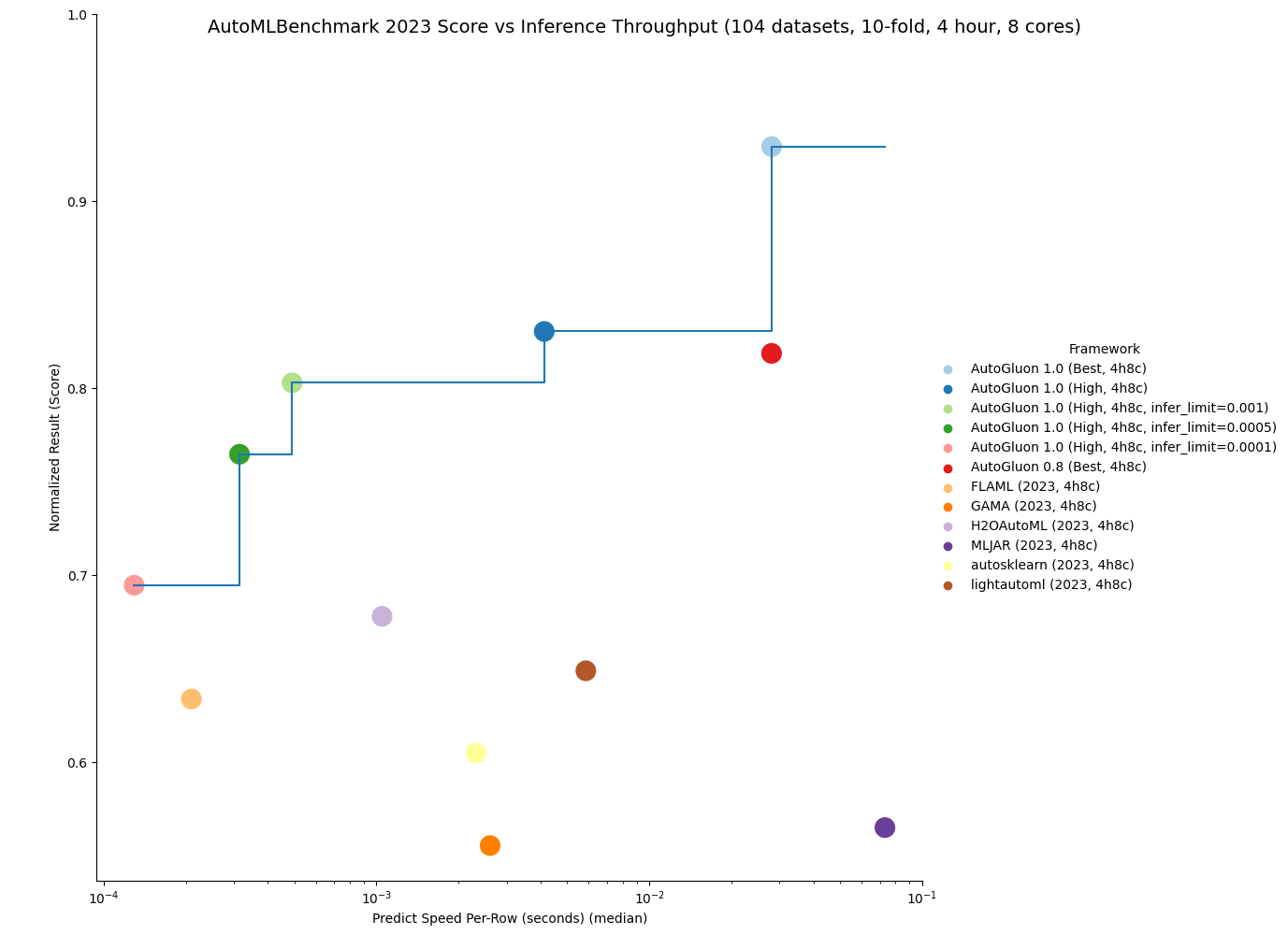
You can get more details on the results here.
We are excited to see what our users can accomplish with AutoGluon 1.0’s enhanced performance. As always, we will continue to improve AutoGluon in future releases to push the boundaries of AutoML forward for all.
AutoGluon Multimodal (AutoMM) Highlights in One Figure

AutoMM Uniqueness
AutoGluon Multimodal (AutoMM) distinguishes itself from other open-source AutoML toolboxes like AutosSklearn, LightAutoML, H2OAutoML, FLAML, MLJAR, TPOT and GAMA, which mainly focus on tabular data for classification or regression. AutoMM is designed for fine-tuning foundation models across multiple modalities—image, text, tabular, and document, either individually or combined. It offers extensive capabilities for tasks like classification, regression, object detection, named entity recognition, semantic matching, and image segmentation. In contrast, other AutoML systems generally have limited support for image or text, typically using a few pretrained models like EfficientNet or hand-crafted rules like bag-of-words as feature extractors. They often rely on traditional models or simple neural networks. AutoMM provides a uniquely comprehensive and versatile approach to AutoML, being the only AutoML system to support flexible multimodality and support for a wide range of tasks. A comparative table detailing support for various data modalities, tasks, and model types is provided below.
Data |
Task |
Model |
||||||||||||
|---|---|---|---|---|---|---|---|---|---|---|---|---|---|---|
image |
text |
tabular |
document |
any combination |
classification |
regression |
object detection |
semantic matching |
named entity recognition |
image segmentation |
traditional models |
deep learning models |
foundation models |
|
LightAutoML |
✓ |
✓ |
✓ |
✓ |
✓ |
✓ |
✓ |
|||||||
H2OAutoML |
✓ |
✓ |
✓ |
✓ |
||||||||||
FLAML |
✓ |
✓ |
✓ |
✓ |
✓ |
✓ |
✓ |
|||||||
MLJAR |
✓ |
✓ |
✓ |
✓ |
||||||||||
AutoSklearn |
✓ |
✓ |
✓ |
✓ |
✓ |
|||||||||
GAMA |
✓ |
✓ |
✓ |
✓ |
||||||||||
TPOT |
✓ |
✓ |
✓ |
✓ |
✓ |
✓ |
||||||||
AutoMM |
✓ |
✓ |
✓ |
✓ |
✓ |
✓ |
✓ |
✓ |
✓ |
✓ |
✓ |
✓ |
✓ |
Special Thanks
We would like to conclude this spotlight by thanking Pieter Gijsbers, Sébastien Poirier, Erin LeDell, Joaquin Vanschoren, and the rest of the AutoML Benchmark authors for their key role in providing a shared and extensive benchmark to monitor the progress of the AutoML field. Their support has been invaluable to the AutoGluon project’s continued growth.
We would also like to thank Frank Hutter, who continues to be a leader within the AutoML field, for organizing the AutoML Conference in 2022 and 2023 to bring the community together to share ideas and align on a compelling vision.
Finally, we would like to thank Alex Smola and Mu Li for championing open source software at Amazon to make this project possible.
Additional Special Thanks
Special thanks to @LennartPurucker for leading development of dynamic stacking
Special thanks to @geoalgo for co-authoring TabRepo to enable Zeroshot-HPO
Special thanks to @ddelange for helping to add Python 3.11 support
Special thanks to @mglowacki100 for providing numerous feedback and suggestions
Special thanks to @Harry-zzh for contributing the new semantic segmentation problem type
General
Highlights
Python 3.11 Support @ddelange @yinweisu (#3190)
Other Enhancements
Added system info logging utility @Innixma (#3718)
Dependency Updates
Upgraded torch to
>=2.0,<2.2@zhiqiangdon @yinweisu @shchur (#3404, #3587, #3588)Upgraded numpy to
>=1.21,<1.29@prateekdesai04 (#3709)Upgraded Pandas to
>=2.0,<2.2@yinweisu @tonyhoo @shchur (#3498)Upgraded scikit-learn to
>=1.3,<1.5@yinweisu @tonyhoo @shchur (#3498)Upgraded Pillow to
>=10.0.1,<11@jaheba (#3688)Upgraded scipy to
>=1.5.4,<1.13@prateekdesai04 (#3709)Upgraded LightGBM to
>=3.3,<4.2@mglowacki100 @prateekdesai04 @Innixma (#3427, #3709, #3733)Upgraded XGBoost to
>=1.6,<2.1@Innixma (#3768)Various minor dependency updates @jaheba (#3689)
Tabular
Highlights
AutoGluon 1.0 features major enhancements to predictive quality, establishing a new state-of-the-art in Tabular modeling. Refer to the spotlight section above for more details!
New Features
Added
dynamic_stackingpredictor fit argument to mitigate stacked overfitting @LennartPurucker @Innixma (#3616)Added zeroshot-HPO learned portfolio as new hyperparameters for
best_qualityandhigh_qualitypresets. @Innixma @geoalgo (#3750)Added experimental scikit-learn API compatible wrappers to TabularPredictor. You can access them via
from autogluon.tabular.experimental import TabularClassifier, TabularRegressor. @Innixma (#3769)Added
predictor.model_failures()@Innixma (#3421)Added enhanced FT-Transformer @taoyang1122 @Innixma (#3621, #3644, #3692)
Added
predictor.simulation_artifact()to support integration with TabRepo @Innixma (#3555)
Performance Improvements
Enhanced FastAI model quality on regression via output clipping @LennartPurucker @Innixma (#3597)
Added Skip-connection Weighted Ensemble @LennartPurucker (#3598)
Fix memory leaks by using ray processes for sequential fitting @LennartPurucker (#3614)
Added dynamic parallel folds support to better utilize compute in low memory scenarios @yinweisu @Innixma (#3511)
Fixed linear model crashes during HPO and added search space for linear models @Innixma (#3571, #3720)
Other Enhancements
Multi-layer stacking now produces deterministic results @LennartPurucker (#3573)
Various model dependency updates @mglowacki100 (#3373)
Various code cleanup and logging improvements @Innixma (#3408, #3570, #3652, #3734)
Bug Fixes / Code and Doc Improvements
Fixed incorrect model memory usage calculation @Innixma (#3591)
Fixed
infer_limitbeing used incorrectly when bagging @Innixma (#3467)Fixed rare edge-case FastAI model crash @Innixma (#3416)
Various minor bug fixes @Innixma (#3418, #3480)
AutoMM
AutoGluon Multimodal (AutoMM) is designed to simplify the fine-tuning of foundation models for downstream applications with just three lines of code. It seamlessly integrates with popular model zoos such as HuggingFace Transformers, TIMM, and MMDetection, providing support for a diverse range of data modalities, including image, text, tabular, and document data, whether used individually or in combination.
New Features
Semantic Segmentation
Introducing the new problem type
semantic_segmentation, for fine-tuning Segment Anything Model (SAM) with three lines of code. @Harry-zzh @zhiqiangdon (#3645, #3677, #3697, #3711, #3722, #3728)Added comprehensive benchmarks from diverse domains, including natural images, agriculture, remote sensing, and healthcare.
Utilizing parameter-efficient finetuning (PEFT) LoRA, showcasing consistent superior performance over alternatives (VPT, adaptor, BitFit, SAM-adaptor, and LST) in the extensive benchmarks.
Added one semantic segmentation tutorial @zhiqiangdon (#3716).
Using SAM-ViT Huge by default (GPU memory > 25GB required).
Few Shot Classification
Added the new
few_shot_classificationproblem type for training few shot classifiers on images or texts. @zhiqiangdon (#3662, #3681, #3695)Leveraging image/text foundation models to extract features and train SVM classifiers.
Added one few shot classification tutorial. @zhiqiangdon (#3662)
Supported torch.compile for faster training (experimental and torch >=2.2 required) @zhiqiangdon (#3520).
Performance Improvements
Improved default image backbones, achieving a 100% win-rate on the image benchmark. @taoyang1122 (#3738)
Replaced MLPs with FT-Transformer as the default tabular backbones, resulting in a 67% win-rate on the text+tabular benchmark. @taoyang1122 (#3732)
Using both the improved default image backbones and FT-Transformer achieves a 62% win-rate on the text+tabular+image benchmark. @taoyang1122 (#3732, #3738)
Stability Enhancements
Enabled rigorous multi-GPU CI testing. @prateekdesai04 (#3566)
Fixed multi-GPU issues. @FANGAreNotGnu (#3617 #3665 #3684 #3691, #3639, #3618)
Enhanced Usability
Supported custom evaluation metrics, which allows defining custom metric object and passing it to the
eval_metricargument. @taoyang1122 (#3548)Supported multi-GPU training in notebooks (experimental). @zhiqiangdon (#3484)
Improved logging with system info. @zhiqiangdon (#3735)
Improved Scalability
The introduction of the new learner class design facilitates easier support for new tasks and data modalities within AutoMM, enhancing overall scalability. @zhiqiangdon (#3650, #3685, #3735)
Other Enhancements
Added the option
hf_text.use_fastfor customizing fast tokenizer usage inhf_textmodels. @zhiqiangdon (#3379)Added fallback evaluation/validation metric, supporting
f1_macrof1_micro, andf1_weighted. @FANGAreNotGnu (#3696)Supported multi-GPU inference with the DDP strategy. @zhiqiangdon (#3445, #3451)
Upgraded torch to 2.0. @zhiqiangdon (#3404)
Upgraded lightning to 2.0 @zhiqiangdon (#3419)
Upgraded torchmetrics to 1.0 @zhiqiangdon (#3422)
Code Improvements
Refactored AutoMM with the learner class for improved design. @zhiqiangdon (#3650, #3685, #3735)
Refactored FT-Transformer. @taoyang1122 (#3621, #3700)
Refactored the visualizers of object detection, semantic segmentation, and NER. @zhiqiangdon (#3716)
Other code refactor/clean-up: @zhiqiangdon @FANGAreNotGnu (#3383 #3399 #3434 #3667 #3684 #3695)
Bug Fixes/Doc Improvements
Fixed HPO for focal loss. @suzhoum (#3739)
Fixed one ONNX export issue. @AnirudhDagar (#3725)
Improved AutoMM introduction for clarity. @zhiqiangdon (#3388 #3726)
Improved AutoMM API doc. @zhiqiangdon @AnirudhDagar (#3772 #3777)
Other bug fixes @zhiqiangdon @FANGAreNotGnu @taoyang1122 @tonyhoo @rsj123 @AnirudhDagar (#3384, #3424, #3526, #3593, #3615, #3638, #3674, #3693, #3702, #3690, #3729, #3736, #3474, #3456, #3590, #3660)
Other doc improvements @zhiqiangdon @FANGAreNotGnu @taoyang1122 (#3397, #3461, #3579, #3670, #3699, #3710, #3716, #3737, #3744, #3745, #3680)
TimeSeries
Highlights
AutoGluon 1.0 features numerous usability and performance improvements to the TimeSeries module. These include automatic handling of missing data and irregular time series, new forecasting metrics (including custom metric support), advanced time series cross-validation options, and new forecasting models. AutoGluon produces state-of-the-art results in forecast accuracy, achieving 70%+ win rate compared to other popular forecasting frameworks.
New features
Support for custom forecasting metrics @shchur (#3760, #3602)
New forecasting metrics
WAPE,RMSSE,SQL+ improved documentation for metrics @melopeo @shchur (#3747, #3632, #3510, #3490)Improved robustness:
TimeSeriesPredictorcan now handle data with all pandas frequencies, irregular timestamps, or missing values represented byNaN@shchur (#3563, #3454)New models: intermittent demand forecasting models based on conformal prediction (
ADIDA,CrostonClassic,CrostonOptimized,CrostonSBA,IMAPA);WaveNetandNPTSfrom GluonTS; new baseline models (Average,SeasonalAverage,Zero) @canerturkmen @shchur (#3706, #3742, #3606, #3459)Advanced cross-validation options: avoid retraining the models for each validation window with
refit_every_n_windowsor adjust the step size between validation windows withval_step_sizearguments toTimeSeriesPredictor.fit@shchur (#3704, #3537)
Enhancements
Enable Ray Tune for deep-learning forecasting models @canerturkmen (#3705)
Support passing multiple evaluation metrics to
TimeSeriesPredictor.evaluate@shchur (#3646)Static features can now be passed directly to
TimeSeriesDataFrame.from_pathandTimeSeriesDataFrame.from_data_frameconstructors @shchur (#3635)
Performance improvements
Much more accurate forecasts at low time limits thanks to new presets and updated logic for splitting the training time across models @shchur (#3749, #3657, #3741)
Faster training and prediction + lower memory usage for
DirectTabularandRecursiveTabularmodels (#3740, #3620, #3559)Enable early stopping and improve inference speed for GluonTS models @shchur (#3575)
Reduce import time for
autogluon.timeseriesby moving import statements inside model classes (#3514)
Bug Fixes / Code and Doc Improvements
Improve log messages @shchur (#3721)
Add reference to the publication on AutoGluon-TimeSeries to README @shchur (#3482)
Align API of
TimeSeriesPredictorwithTabularPredictor, remove deprecated methods @shchur (#3714, #3655, #3396)General bug fixes and improvements @shchur(#3758, #3756, #3755, #3754, #3746, #3743, #3727, #3698, #3654, #3653, #3648, #3628, #3588, #3560, #3558, #3536, #3533, #3523, #3522, #3476, #3463)
EDA
The EDA module will be released at a later time, as it requires additional development effort before it is ready for 1.0.
We will make an announcement when EDA is ready for release. For now, please continue to use "autogluon.eda==0.8.2".
Deprecations
General
autogluon.core.spaceshas been deprecated. Please useautogluon.common.spacesinstead @Innixma (#3701)
Tabular
Tabular will log warnings if using the deprecated methods. Deprecated methods are planned to be removed in AutoGluon 1.2 @Innixma (#3701)
autogluon.tabular.TabularPredictorpredictor.get_model_names()->predictor.model_names()predictor.get_model_names_persisted()->predictor.model_names(persisted=True)predictor.compile_models()->predictor.compile()predictor.persist_models()->predictor.persist()predictor.unpersist_models()->predictor.unpersist()predictor.get_model_best()->predictor.model_bestpredictor.get_pred_from_proba()->predictor.predict_from_proba()predictor.get_oof_pred_proba()->predictor.predict_proba_oof()predictor.get_oof_pred()->predictor.predict_oof()predictor.get_model_full_dict()->predictor.model_refit_map()predictor.get_size_disk()->predictor.disk_usage()predictor.get_size_disk_per_file()->predictor.disk_usage_per_file()predictor.leaderboard()silentargument deprecated, replaced bydisplay, defaults to FalseSame for
predictor.evaluate()andpredictor.evaluate_predictions()
AutoMM
Deprecated the
FewShotSVMPredictorin favor of the newfew_shot_classificationproblem type @zhiqiangdon (#3699)Deprecated the
AutoMMPredictorin favor ofMultiModalPredictor@zhiqiangdon (#3650)autogluon.multimodal.MultiModalPredictorDeprecated the
configargument in the fit API. @zhiqiangdon (#3679)Deprecated the
init_scratchandpipelinearguments in the init API @zhiqiangdon (#3668)
TimeSeries
autogluon.timeseries.TimeSeriesPredictorDeprecated argument
TimeSeriesPredictor(ignore_time_index: bool). Now, if the data contains irregular timestamps, either convert it to regular frequency withdata = data.convert_frequency(freq)or provide frequency when creating the predictor asTimeSeriesPredictor(freq=freq).predictor.evaluate()now returns a dictionary (previously returned a float)predictor.score()->predictor.evaluate()predictor.get_model_names()->predictor.model_names()predictor.get_model_best()->predictor.model_bestMetric
"mean_wQuantileLoss"has been renamed to"WQL"predictor.leaderboard()silentargument deprecated, replaced bydisplay, defaults to FalseWhen setting
hyperparametersto a string inpredictor.fit(), supported values are now"default","light"and"very_light"
autogluon.timeseries.TimeSeriesDataFramedf.to_regular_index()->df.convert_frequency()Deprecated method
df.get_reindexed_view(). Please see deprecation notes forignore_time_indexunderTimeSeriesPredictorabove for information on how to deal with irregular timestamps
Models
All models based on MXNet (
DeepARMXNet,MQCNNMXNet,MQRNNMXNet,SimpleFeedForwardMXNet,TemporalFusionTransformerMXNet,TransformerMXNet) have been removedStatistical models from Statmodels (
ARIMA,Theta,ETS) have been replaced by their counterparts from StatsForecast (#3513). Note that these models now have different hyperparameter names.DirectTabularis now implemented usingmlforecastbackend (same asRecursiveTabular), most hyperparameter names for the model have changed.
autogluon.timeseries.TimeSeriesEvaluatorhas been deprecated. Please use metrics available inautogluon.timeseries.metricsinstead.autogluon.timeseries.splitter.MultiWindowSplitterandautogluon.timeseries.splitter.LastWindowSplitterhave been deprecated. Please usenum_val_windowsandval_step_sizearguments toTimeSeriesPredictor.fitinstead (alternatively, useautogluon.timeseries.splitter.ExpandingWindowSplitter).
Papers
AutoGluon-TimeSeries: AutoML for Probabilistic Time Series Forecasting
We have published a paper on AutoGluon-TimeSeries at AutoML Conference 2023 (Paper Link, YouTube Video). In the paper, we benchmarked AutoGluon and popular open-source forecasting frameworks (including DeepAR, TFT, AutoARIMA, AutoETS, AutoPyTorch). AutoGluon produces SOTA results in point and probabilistic forecasting, and even achieves 65% win rate against the best-in-hindsight combination of models.
TabRepo: A Large Scale Repository of Tabular Model Evaluations and its AutoML Applications
We have published a paper on Tabular Zeroshot-HPO ensembling simulation to arXiv (Paper Link, GitHub). This paper is key to achieving the performance improvements seen in AutoGluon 1.0, and we plan to continue to develop the code-base to support future enhancements.
XTab: Cross-table Pretraining for Tabular Transformers
We have published a paper on tabular Transformer pre-training at ICML 2023 (Paper Link, GitHub). In the paper we demonstrate state-of-the-art performance for tabular deep learning models, including being able to match the performance of XGBoost and LightGBM models. While the pre-trained transformer is not yet incorporated into AutoGluon, we plan to integrate it in a future release.
Learning Multimodal Data Augmentation in Feature Space
Our paper on learning multimodal data augmentation was accepted at ICLR 2023 (Paper Link, GitHub). This paper introduces a plug-and-play module to learn multimodal data augmentation in feature space, with no constraints on the identities of the modalities or the relationship between modalities. We show that it can (1) improve the performance of multimodal deep learning architectures, (2) apply to combinations of modalities that have not been previously considered, and (3) achieve state-of-the-art results on a wide range of applications comprised of image, text, and tabular data. This work is not yet incorporated into AutoGluon, but we plan to integrate it in a future release.
Data Augmentation for Object Detection via Controllable Diffusion Models
Our paper on generative object detection data augmentation has been accepted at WACV 2024 (Paper and GitHub link will be available soon). This paper proposes a data augmentation pipeline based on controllable diffusion models and CLIP, with visual prior generation to guide the generation and post-filtering by category-calibrated CLIP scores to control its quality. We demonstrate that the performance improves across various tasks and settings when using our augmentation pipeline with different detectors. Although diffusion models are currently not integrated into AutoGluon, we plan to incorporate the data augmentation techniques in a future release.
Adapting Image Foundation Models for Video Understanding
We have published a paper on how to efficiently adapt image foundation models for video understanding at ICLR 2023 (Paper Link, GitHub). This paper introduces spatial adaptation, temporal adaptation and joint adaptation to gradually equip a frozen image model with spatiotemporal reasoning capability. The proposed method achieves competitive or even better performance than traditional full finetuning while largely saving the training cost of large foundation models.
v0.8.2
Version 0.8.2
v0.8.2 is a hot-fix release to pin pydantic version to avoid crashing during HPO
As always, only load previously trained models using the same version of AutoGluon that they were originally trained on. Loading models trained in different versions of AutoGluon is not supported.
See the full commit change-log here: https://github.com/autogluon/autogluon/compare/0.8.1…0.8.2
This version supports Python versions 3.8, 3.9, and 3.10.
Changes
codespell: action, config + some typos fixed @yarikoptic @yinweisu (#3323)
Unpin sentencepiece @zhiqiangdon (#3368)
Pin pydantic @yinweisu (3370)
v0.8.1
Version 0.8.1
v0.8.1 is a bug fix release.
As always, only load previously trained models using the same version of AutoGluon that they were originally trained on. Loading models trained in different versions of AutoGluon is not supported.
See the full commit change-log here: https://github.com/autogluon/autogluon/compare/v0.8.0…v0.8.1
This version supports Python versions 3.8, 3.9, and 3.10.
Changes
Documentation improvements
Update google analytics property @gidler (#3330)
Add Discord Link @Innixma (#3332)
Add community section to website front page @Innixma (#3333)
Update Windows Conda install instructions @gidler (#3346)
Add some missing Colab buttons in tutorials @gidler (#3359)
Bug Fixes / General Improvements
Move PyMuPDF to optional @Innixma @zhiqiangdon (#3331)
Remove TIMM in core setup @Innixma (#3334)
Update persist_models max_memory 0.1 -> 0.4 @Innixma (#3338)
Lint modules @yinweisu (#3337, #3339, #3344, #3347)
Remove fairscale @zhiqiangdon (#3342)
Fix refit crash @Innixma (#3348)
Fix
DirectTabularmodel failing for some metrics; hide warnings produced byAutoARIMA@shchur (#3350)Pin dependencies @yinweisu (#3358)
Reduce per gpu batch size for AutoMM high_quality_hpo to avoid out of memory error for some corner cases @zhiqiangdon (#3360)
Fix HPO crash by setting reuse_actor to False @yinweisu (#3361)
v0.8.0
Version 0.8.0
We’re happy to announce the AutoGluon 0.8 release.
Note: Loading models trained in different versions of AutoGluon is not supported.
This release contains 196 commits from 20 contributors!
See the full commit change-log here: https://github.com/autogluon/autogluon/compare/0.7.0…0.8.0
Special thanks to @geoalgo for the joint work in generating the experimental tabular Zeroshot-HPO portfolio this release!
Full Contributor List (ordered by # of commits):
@shchur, @Innixma, @yinweisu, @gradientsky, @FANGAreNotGnu, @zhiqiangdon, @gidler, @liangfu, @tonyhoo, @cheungdaven, @cnpgs, @giswqs, @suzhoum, @yongxinw, @isunli, @jjaeyeon, @xiaochenbin9527, @yzhliu, @jsharpna, @sxjscience
AutoGluon 0.8 supports Python versions 3.8, 3.9, and 3.10.
Changes
Highlights
AutoGluon TimeSeries introduced several major improvements, including new models, upgraded presets that lead to better forecast accuracy, and optimizations that speed up training & inference.
AutoGluon Tabular now supports calibrating the decision threshold in binary classification (API), leading to massive improvements in metrics such as
f1andbalanced_accuracy. It is not uncommon to seef1scores improve from0.70to0.73as an example. We strongly encourage all users who are using these metrics to try out the new decision threshold calibration logic.AutoGluon MultiModal introduces two new features: 1) PDF document classification, and 2) Open Vocabulary Object Detection.
AutoGluon MultiModal upgraded the presets for object detection, now offering
medium_quality,high_quality, andbest_qualityoptions. The empirical results demonstrate significant ~20% relative improvements in the mAP (mean Average Precision) metric, using the same preset.AutoGluon Tabular has added an experimental Zeroshot HPO config which performs well on small datasets <10000 rows when at least an hour of training time is provided (~60% win-rate vs
best_quality). To try it out, specifypresets="experimental_zeroshot_hpo_hybrid"when callingfit().AutoGluon EDA added support for Anomaly Detection and Partial Dependence Plots.
AutoGluon Tabular has added experimental support for TabPFN, a pre-trained tabular transformer model. Try it out via
pip install autogluon.tabular[all,tabpfn](hyperparameter key is “TABPFN”)!
General
General doc improvements @tonyhoo @Innixma @yinweisu @gidler @cnpgs @isunli @giswqs (#2940, #2953, #2963, #3007, #3027, #3059, #3068, #3083, #3128, #3129, #3130, #3147, #3174, #3187, #3256, #3258, #3280, #3306, #3307, #3311, #3313)
General code fixes and improvements @yinweisu @Innixma (#2921, #3078, #3113, #3140, #3206)
CI improvements @yinweisu @gidler @yzhliu @liangfu @gradientsky (#2965, #3008, #3013, #3020, #3046, #3053, #3108, #3135, #3159, #3283, #3185)
New AutoGluon Webpage @gidler @shchur (#2924)
Support sample_weight in RMSE @jjaeyeon (#3052)
Move AG search space to common @yinweisu (#3192)
Deprecation utils @yinweisu (#3206, #3209)
Update namespace packages for PEP420 compatibility @gradientsky (#3228)
Multimodal
AutoGluon MultiModal (also known as AutoMM) introduces two new features: 1) PDF document classification, and 2) Open Vocabulary Object Detection. Additionally, we have upgraded the presets for object detection, now offering medium_quality, high_quality, and best_quality options. The empirical results demonstrate significant ~20% relative improvements in the mAP (mean Average Precision) metric, using the same preset.
New Features
PDF Document Classification. See tutorial @cheungdaven (#2864, #3043)
Open Vocabulary Object Detection. See tutorial @FANGAreNotGnu (#3164)
Performance Improvements
Upgrade the detection engine from mmdet 2.x to mmdet 3.x, and upgrade our presets @FANGAreNotGnu (#3262)
medium_quality: yolo-s -> yolox-lhigh_quality: yolox-l -> DINO-Res50best_quality: yolox-x -> DINO-Swin_l
Speedup fusion model training with deepspeed strategy. @liangfu (#2932)
Enable detection backbone freezing to boost finetuning speed and save GPU usage @FANGAreNotGnu (#3220)
Other Enhancements
Support passing data path to the fit() API @zhiqiangdon (#3006)
Upgrade TIMM to the latest v0.9.* @zhiqiangdon (#3282)
Support xywh output for object detection @FANGAreNotGnu (#2948)
Fusion model inference acceleration with TensorRT @liangfu (#2836, #2987)
Support customizing advanced image data augmentation. Users can pass a list of torchvision transform objects as image augmentation. @zhiqiangdon (#3022)
Add yoloxm and yoloxtiny @FangAreNotGnu (#3038)
Add MultiImageMix Dataset for Object Detection @FangAreNotGnu (#3094)
Support loading specific checkpoints. Users can load the intermediate checkpoints other than model.ckpt and last.ckpt. @zhiqiangdon (#3244)
Add some predictor properties for model statistics @zhiqiangdon (#3289)
trainable_parametersreturns the number of trainable parameters.total_parametersreturns the number of total parameters.model_sizereturns the model size measured by megabytes.
Bug Fixes / Code and Doc Improvements
General bug fixes and improvements @zhiqiangdon @liangfu @cheungdaven @xiaochenbin9527 @Innixma @FANGAreNotGnu @gradientsky @yinweisu @yongxinw (#2939, #2989, #2983, #2998, #3001, #3004, #3006, #3025, #3026, #3048, #3055, #3064, #3070, #3081, #3090, #3103, #3106, #3119, #3155, #3158, #3167, #3180, #3188, #3222, #3261, #3266, #3277, #3279, #3261, #3267)
General doc improvements @suzhoum (#3295, #3300)
Remove clip from fusion models @liangfu (#2946)
Refactor inferring problem type and output shape @zhiqiangdon (#3227)
Log GPU info including GPU total memory, free memory, GPU card name, and CUDA version during training @zhiqaingdon (#3291)
Tabular
New Features
Added
calibrate_decision_threshold(tutorial), which allows to optimize a given metric’s decision threshold for predictions to strongly enhance the metric score. @Innixma (#3298)We’ve added an experimental Zeroshot HPO config, which performs well on small datasets <10000 rows when at least an hour of training time is provided. To try it out, specify
presets="experimental_zeroshot_hpo_hybrid"when callingfit()@Innixma @geoalgo (#3312)The TabPFN model is now supported as an experimental model. TabPFN is a viable model option when inference speed is not a concern, and the number of rows of training data is less than 10,000. Try it out via
pip install autogluon.tabular[all,tabpfn]! @Innixma (#3270)Backend support for distributed training, which will be available with the next Cloud module release. @yinweisu (#3054, #3110, #3115, #3131, #3142, #3179, #3216)
Performance Improvements
Accelerate boolean preprocessing @Innixma (#2944)
Other Enhancements
Add quantile regression support for CatBoost @shchur (#3165)
Implement quantile regression for LGBModel @shchur (#3168)
Log to file support @yinweisu (#3232)
Add support for
included_model_types@yinweisu (#3239)Add enable_categorical=True support to XGBoost @Innixma (#3286)
Bug Fixes / Code and Doc Improvements
Cross-OS loading of a fit TabularPredictor should now work properly @yinweisu @Innixma
General bug fixes and improvements @Innixma @cnpgs @shchur @yinweisu @gradientsky (#2865, #2936, #2990, #3045, #3060, #3069, #3148, #3182, #3199, #3226, #3257, #3259, #3268, #3269, #3287, #3288, #3285, #3293, #3294, #3302)
Move interpretable logic to InterpretableTabularPredictor @Innixma (#2981)
Enhance drop_duplicates, enable by default @Innixma (#3010)
Refactor params_aux & memory checks @Innixma (#3033)
Raise regression
pred_proba@Innixma (#3240)
TimeSeries
In v0.8 we introduce several major improvements to the Time Series module, including new models, upgraded presets that lead to better forecast accuracy, and optimizations that speed up training & inference.
Highlights
New models:
PatchTSTandDLinearfrom GluonTS, andRecursiveTabularbased on integration with themlforecastlibrary @shchur (#3177, #3184, #3230)Improved accuracy and reduced overall training time thanks to updated presets @shchur (#3281, #3120)
3-6x faster training and inference for
AutoARIMA,AutoETS,Theta,DirectTabular,WeightedEnsemblemodels @shchur (#3062, #3214, #3252)
New Features
Dramatically faster repeated calls to
predict(),leaderboard()andevaluate()thanks to prediction caching @shchur (#3237)Reduce overfitting by using multiple validation windows with the
num_val_windowsargument tofit()@shchur (#3080)Exclude certain models from presets with the
excluded_model_typesargument tofit()@shchur (#3231)New method
refit_full()that refits models on combined train and validation data @shchur (#3157)Train multiple configurations of the same model by providing lists in the
hyperparametersargument @shchur (#3183)Time limit set by
time_limitis now respected by all models @shchur (#3214)
Enhancements
Improvements to the
DirectTabularmodel (previously calledAutoGluonTabular): faster featurization, trained as a quantile regression model ifeval_metricis set to"mean_wQuantileLoss"@shchur (#2973, #3211)Use correct seasonal period when computing the MASE metric @shchur (#2970)
Check the AutoGluon version when loading
TimeSeriesPredictorfrom disk @shchur (#3233)
Minor Improvements / Documentation / Bug Fixes
Update documentation and tutorials @shchur (#2960, #2964, #3296, #3297)
General bug fixes and improvements @shchur (#2977, #3058, #3066, #3160, #3193, #3202, #3236, #3255, #3275, #3290)
Exploratory Data Analysis (EDA) tools
In 0.8 we introduce a few new tools to help with data exploration and feature engineering:
Anomaly Detection @gradientsky (#3124, #3137) - helps to identify unusual patterns or behaviors in data that deviate significantly from the norm. It’s best used when finding outliers, rare events, or suspicious activities that could indicate fraud, defects, or system failures. Check the Anomaly Detection Tutorial to explore the functionality.
Partial Dependence Plots @gradientsky (#3071, #3079) - visualize the relationship between a feature and the model’s output for each individual instance in the dataset. Two-way variant can visualize potential interactions between any two features. Please see this tutorial for more detail: Using Interaction Charts To Learn Information About the Data
Bug Fixes / Code and Doc Improvements
Switch regression analysis in
quick_fitto use residuals plot @gradientsky (#3039)Added
explain_rowsmethod toautogluon.eda.auto- Kernel SHAP visualization @gradientsky (#3014)General improvements and fixes @gradientsky (#2991, #3056, #3102, #3107, #3138)